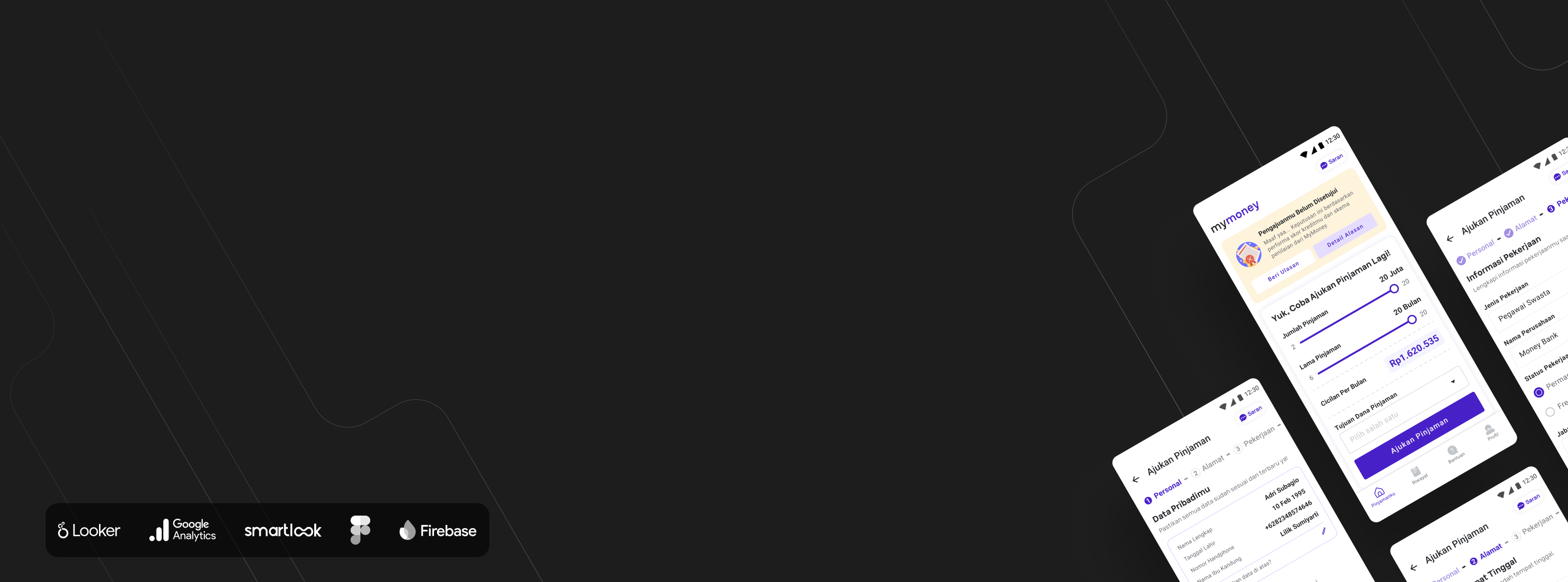
Simplifying the
Rejected Loan
Reapply Flow
Merging processes to skip redundant pages, reduce user mental workload, and meaningfully boost reapplication conversions.
*UI visuals have been anonymized at the company's request. Layout, interaction, and patterns reflect the actual shipped design.
Overview
The experiment focused on streamlining the loan reapplication process for users who had previously been rejected. I identified that the original reapply journey forced users through five separate steps before submission, creating avoidable friction before users even reached the form.
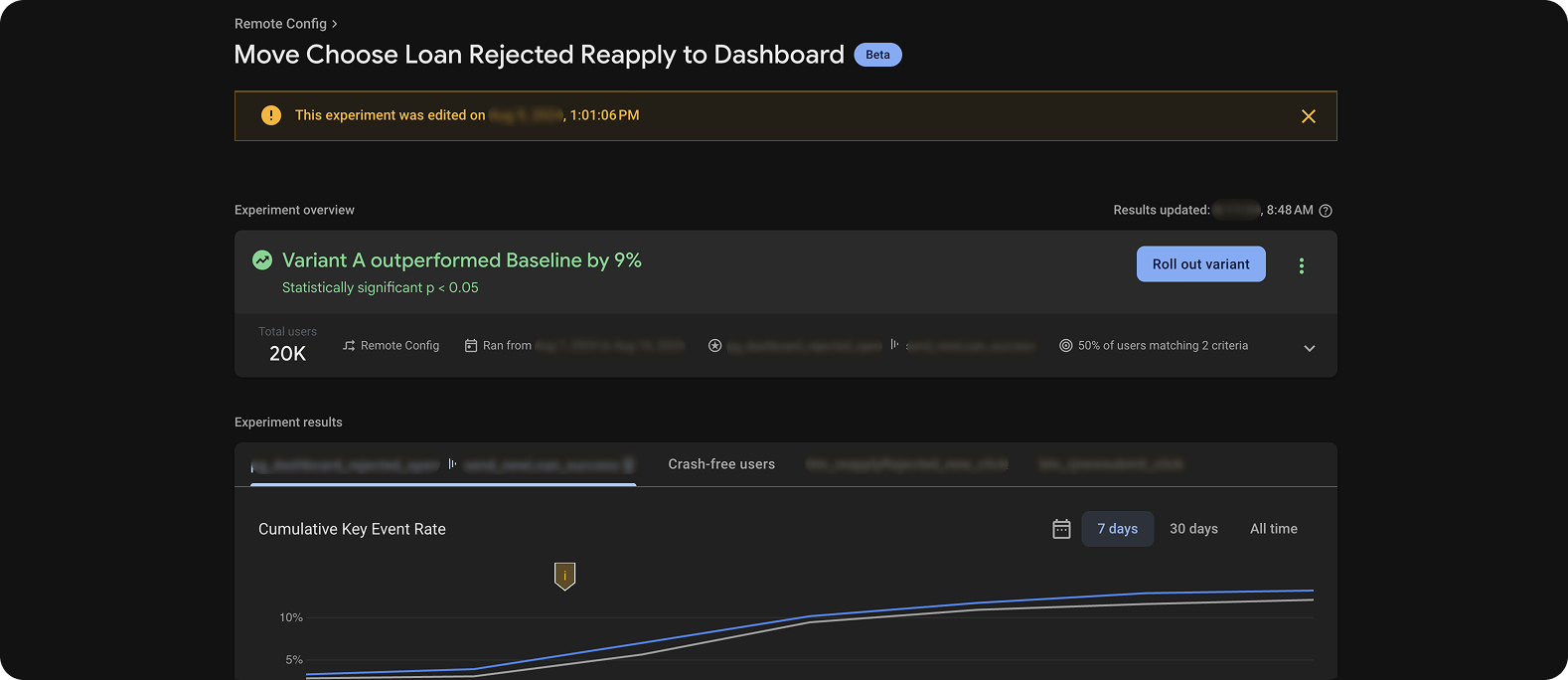
Result: The new flow increased end-to-end conversion, outperformed the baseline by 9% that was statistically significant. Additional disbursement estimation: +IDR 550M
Context
When users open the app after a rejected application, they land on a specific dashboard state. From there, they were forced to load a standalone module to configure their loan simulation, a disjointed step that sat between two screens with nearly identical intent.
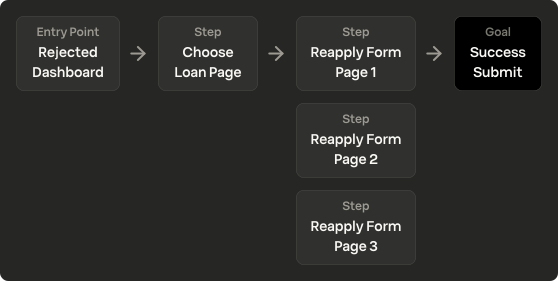
The numbers we regularly monitor using Looker and Google Analytics tell a clear story: once users entered the reapply form, they converted well. But the end-to-end rate, from opening the rejected dashboard to successfully submitting, was significantly lower. Most of the drop-off was happening before users even reached the form. The funnel was leaking at the top, not the bottom.
"Rejected users are already motivated, they came back. The question is whether the flow meets them with encouragement or friction. Surfacing loan exploration at the dashboard gives them a reason to continue before they've had a chance to leave."
Problem
The existing flow separated two things users needed to do in sequence: see their rejected status, then configure a new loan. Putting these on separate pages added a page load, a CTA tap, and a context switch, all before the user had even started their reapplication. But the deeper issue was a missed opportunity. Rejected users are a motivated audience: they already wanted a loan. I believed surfacing the loan simulation immediately after rejection would reduce hesitation and encourage users to reconsider reapplying before leaving the flow. Instead, the flow buried that experience several steps in, long after many users had already left.
Objective
Increase the conversion rate from:
Open Rejected Dashboard → Successful Reapply Submission
Success criteria, A measurable and statistically significant uplift in end-to-end conversion versus baseline.
Design Exploration
I led the design direction for Variant A by focusing on reducing friction at a critical drop-off point: the rejected state.
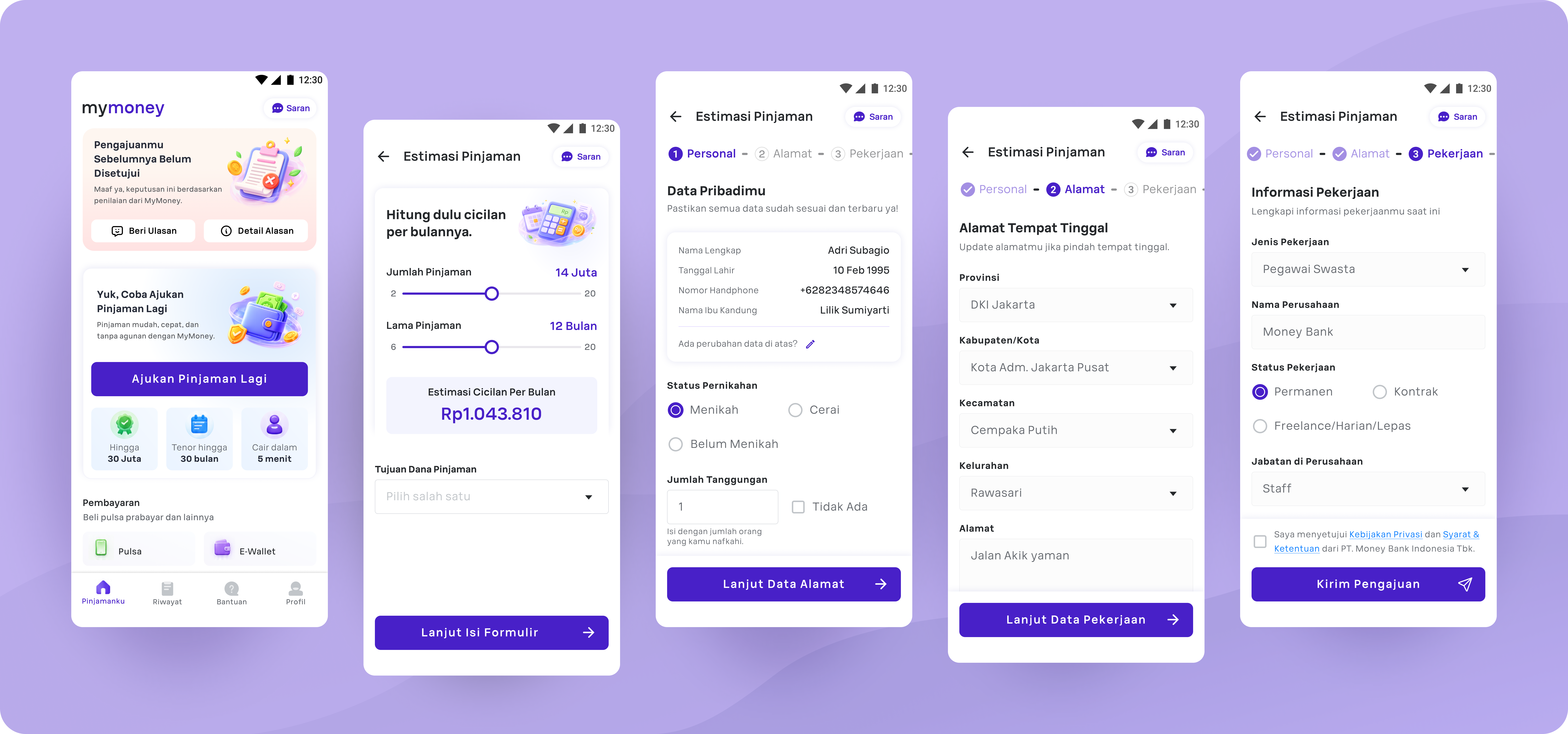
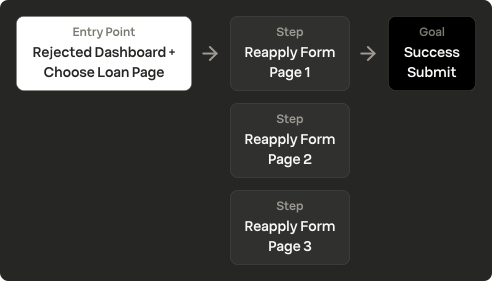
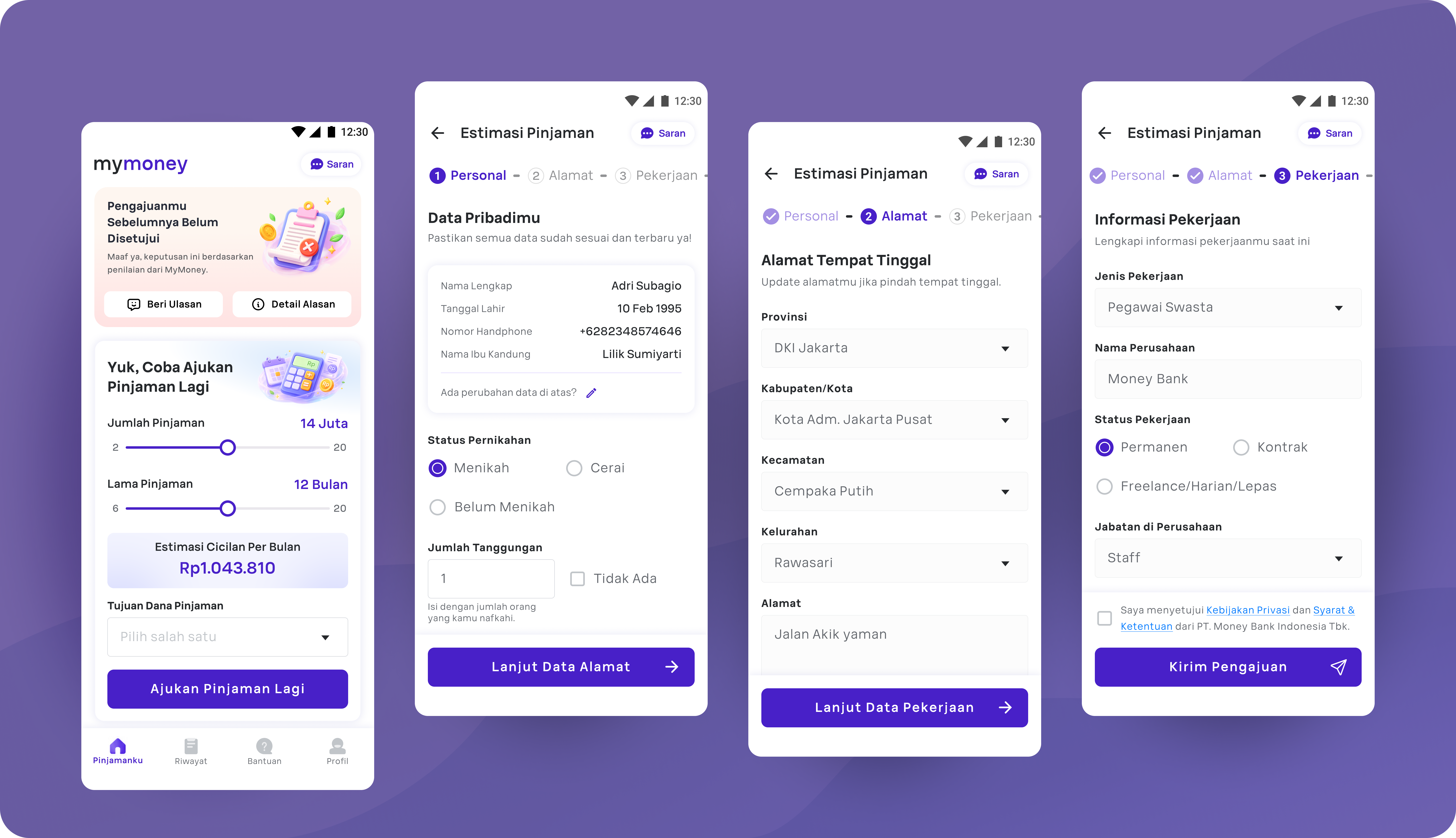
The key decision was to integrate the loan simulation directly into the rejected dashboard. Rather than redirecting users into a separate module, I merged loan exploration into the rejected state itself so users could immediately reassess options without breaking momentum. The goal was to eliminate unnecessary steps and enable faster recovery from rejection.
My hypothesis was that rejected users still had strong intent, that they are more likely to reconsider if the path to reapply is immediate, visible, and requires minimal effort.
Beyond restructuring the flow, I refined supporting elements that could influence confidence and continuation during the rejection state:
- Copywriting was adjusted to be more reassuring and action-oriented, reducing the emotional friction associated with rejection.
- Primary CTA was repositioned and reframed to emphasize continuation rather than restart.
- USP highlights were clarified to reinforce product value and rebuild user confidence at this sensitive moment.
Overall, Variant A shifts the experience from a dead-end rejection into a guided recovery flow, enabling users to take corrective action with minimal interruption.
To ensure the solution was not only conceptually strong but also effective in practice, the design went through multiple validation cycles. I ran lightweight usability sessions to understand whether users immediately recognized the embedded simulation as the next actionable step after rejection. Early findings showed that users initially overlooked the simulation module and hesitated to take action when the next step was not immediately clear.
Based on those findings, I reworked the hierarchy by increasing simulation prominence, simplifying supporting copy, and repositioning the CTA closer to the interactive area, ensuring that key actions, such as adjusting loan parameters and reapplying, remained visible and intuitive.
As a result, the final design improved clarity and reduced hesitation, enabling users to move from rejection to action more confidently.
Experiment
The change was validated through an A/B test using Firebase A/B Testing with a two-proportion Z-test for statistical analysis. Users were split 50/50 between the baseline flow and Variant A.
After rollout, I monitored session recordings and behavioral patterns through Smartlook to identify hesitation points and validate whether users were progressing through the new flow as intended.
Confidence level
99%
Statistical method
Z-test
Two-proportion
Sample size
10,000
50/50 split
Duration
1 week
Firebase A/B Testing
Open rejected dashboard → success submit reapply form
Open rejected dashboard → entry point click
Result
| Metric | Direction | p-value | Outcome |
|---|---|---|---|
| Primary main | Increased ↑ | 0.016 | Significant |
| Secondary | Slight increase | 0.331 | No sig. diff. |
The primary metric showed a statistically significant improvement (p = 0.016). Merging the loan simulation into the rejected dashboard, combined with updated copy and CTAs, meaningfully lifted the number of users who completed a reapplication, confirming that reducing the funnel from 5 to 4 pages removed enough friction to change user behavior.
Business Impact & Decision
After the experiment reached statistical significance on the primary metric, I recommended Variant A for full rollout based on its measurable conversion lift and projected business impact.
End-to-end conversion rate increased significantly, the variant A outperformed the baseline by 9%.
Projected to meaningfully increase monthly loan applications and disbursement volume by +IDR 550M.
5 → 4 pages, one full page removed from the reapply journey